This is how boys greet everybody in AKL airport, before you even get to immigration. Actually there is a girl there, too.
Friday, 30 August 2019
Friday, 19 July 2019
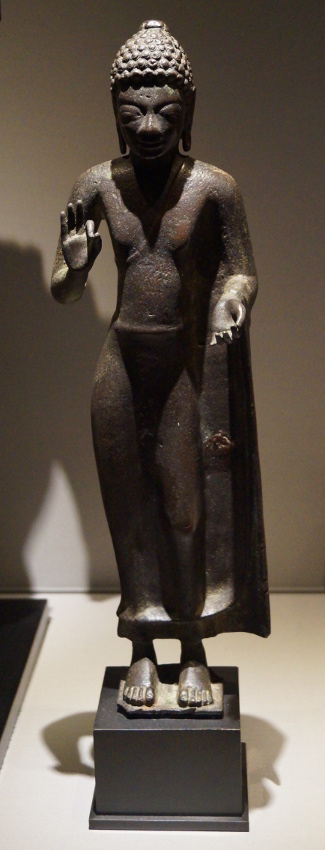
Buddhas in Singapore museum
In Europe one can go to museums to see European art but in Singapore the best museum concentrates its attention on Asian art. One can see for example the development of a Buddha figure throughout the ages and in many countries. Here are just a few of them.
| Buddha from Gandhara (today's Afghanistan), 3rd century |
| Buddha from Java, 8th century, |
| Buddha from North India, 9th century |
| Buddha from Thailand, 15th century |
| Buddha from Tibet, 16th century |
| Standing Buddha from North India, 10th century |
| Buddha from China, 6th century |
| Standing Buddha from Cambodja, 5th century |
Sunday, 14 July 2019
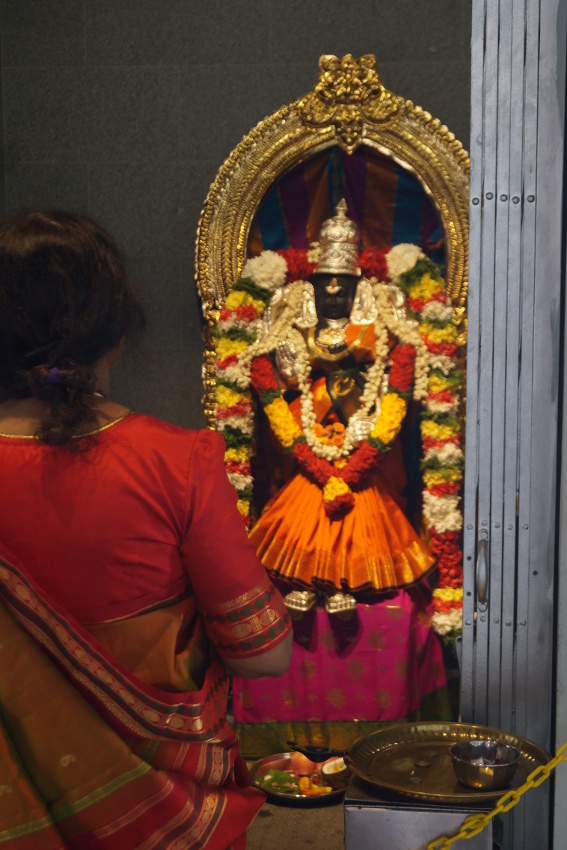
Hindu temple in Singapore
This is a Hindu temple in Singapore.
Hindus come to a temple for a "darshan", or seeing the face of God. Hinduism is of course a religion of many currents, for ascetics this darshan is achieved after a long meditation, but for ordinary people it is a visit in a temple to see a face of a figure. This is what the figure is there for. There is a special ceremony, analogous to the Catholic transfiguration, after which it becomes a body of God, very much like the Catholic host. It is not eaten but treated like a host in a monstrance. The priests treat this figure as a living being, they wash it, bring meals to it, put to bed. Which is a bit similar to figures of saints in Latin countries, where the figures are clad, and the clothing is regularly changed and washed.
Monday, 8 July 2019
Singapore old and new
A mixture of old and new and all world traditions can be seen at every corner in Singapore. They seem to connect well there. Just a few vistas here to illustrate this.
Monday, 1 July 2019
BC Indian hats
Do you think American Indian traditional head covering is a feather bonnet? Well, not in British Columbia. There the traditional head covering is a basket. A properly traditional one should be made with tree roots although nowadays one can see cheaper ones, perhaps not made in China but using some other than traditional materials. Anyway don't you dare put on a bonnet if you happen to paddle one of the traditional Indian ocean-going boats.
All these pictures were taken during a rally of such boats in 2014 in Alert Bay.
Monday, 24 June 2019
St Louis Bible in Toledo
In Toledo most tourists want to see pictures of El Greco, so they crowd in Sacristy in the cathedral, but other things often ignore. These other things are not written about in papers, so they are not famous. If they are not famous, then perhaps they are not important.
This is the case with the Bible of Saint Louis, which is exhibited in the Toledo Cathedral. It is an exquisite book of 13th century, but most of the crowd, who have to pass in front of it when they leave the sacristy, don't even stop to have a look.
Sunday, 16 June 2019
Plafond in Toledo
Most tourists in Toledo
go to the cathedral to see pictures by El Greco in the sacristy. Few
people, however, look at the ceiling there. There is a painting
on the ceiling, and quite an impressive one, too. El Greco, however, is famous, whereas the author
of the painting on the ceiling is little known and most guide books
never mention it. Who would look at the ceiling when standing in
front of an original El Greco?
I, however, think that
the ceiling is very interesting. It shows the heavens open with God
(shown there as a bright disc with Hebrew letters IHWH written on it)
and a crowd of angels and saints singing probably hymns of praise. At
the edge of the painting there are also some people unpleasantly
surprised by the vision. This is an illusionist painting that is
supposed to give an impression that there is no ceiling but the open
heaven instead. During the baroque era in Catholic Europe this was
quite popular theme, the best known example being probably the
plafond of St Ignacio in Rome, but the Toledo example is certainly
very good. Its author (as some guide books mention) is a Neapolitan
painter Luca Giordano.
Subscribe to:
Posts (Atom)